|
|

- this is a thumb: click below on 'sheet music' or 'enlargement' -
|
|
© copyright translations, sheet music and music
 sheet music / enlargement sheet music / enlargement
 play music / or click here play music / or click here
The farmer had just one shoe
not much, enough, enough, enough!
The farmer had just one shoe
not much, enough!
A shoe with no heel on it
the farmer's no nobleman,
a shoe with no heel on it
the farmer is no nobleman!
De boer had maar enen schoen
weinig genoeg, genoeg, genoeg!
De boer had maar enen schoen
weinig genoeg!
Een schoen zonder hak eran
de boer is geen edelman,
een schoen zonder hak eran
de boer die is geen edelman!
The farmer had just one pants
not much, enough, enough, enough!
The farmer had just one pants
not much, enough!
A pants with no pockets there,
the farmer's no nobleman,
a pants with no pockets there,
the farmer is no nobleman!
De boer had maar enen broek
weinig genoeg, genoeg, genoeg!
De boer had maar enen broek
weinig genoeg!
Een broek zonder zak erin
de boer is geen edelman,
een broek zonder zak erin
de boer die is geen edelman!
etc.:
a coat with no button there
a cap with no peak on it
a sock with an hole in it
enz.:
een jas zonder knoop eran
een pet zonder klep eran
een kous met een gat erin
The farmer had just one wife
more than enough, enough, enough!
The farmer had just one wife
more than enough!
A wife with a head on top
the famer had such bad luck,
a wife with a head on top
the farmer he had such bad luck!
De boer had maar ene vrouw
meer dan genoeg, genoeg, genoeg!
De boer had maar ene vrouw
meer dan genoeg!
Een vrouw met een kop erop
de boer had een reuzestrop,
een vrouw met een kop erop
de boer die had een reuzestrop!
|
|
|
Historic Dutch folk song.
Commentary: This folk song was written down from the oral tradition around 1930. The songwriter is unknown and the song can't be dated.
The song has a distinct characteristic of historic folk songs from the oral tradition: repeating sentences, which makes it easy to sing along and indicates the practise of community singing.
Sources (Dutch Song Database):
• Wouters en Moormann, Het straatlied (1933)
• Pollmann en Tiggers, Nederlands volkslied (1956, 1977)
 Lyrics 'De boer had maar enen schoen' on Dutch website: Nederlandse volksliedjes B. Lyrics 'De boer had maar enen schoen' on Dutch website: Nederlandse volksliedjes B.
|
|

- this is a thumb: click below on 'sheet music' or 'enlargement' -
|
|
© copyright translations, sheet music and music
sheet music / enlargement
play music / or click here
A farmer went to his neighbour, hai famer hai
a farmer went to his neighbour, hai famer hai
his wife wants to go with him, dom dom dom dai
his wife wants to go with him, dom dom dom dai.
Ain boer wol noar zien noaber tou, hai boer hai
ain boer wol noar zien noaber tou, hai boer hai
zien wief dij wol mit hom goan, dom dom dom dai
zien wief dij wol mit hom goan, dom dom dom dai.
"No, wife, you have to stay at home", hai famer hai
"no, wife, you have to stay at home", hai famer hai
"you have to spin wool and sew", dom dom dom dai
"you have to spin wool and sew", dom dom dom dai.
"Nee wief, doe most thoeze bliev'n", hai boer hai
"nee wief, doe most thoeze bliev'n", hai boer hai
"most spinn'n en naai'n", van dom dom dom dai
"most spinn'n en naai'n", van dom dom dom dai.
The farmer came home again, hai famer hai
the farmer came home again, hai famer hai
and asked: "Wife, what did you do?", dom dom dom dai
and asked: "Wife, what did you do?", dom dom dom dai.
Dou boer weer ien hoeze kwam, hai boer hai
dou boer weer ien hoeze kwam, hai boer hai
zee'e: "Wief, wat hestoe wel doan?" dom dom dom dai
zee'e: "Wief, wat hestoe wel doan?" dom dom dom dai.
But she took the cupboardbed stick, hai famer hai
but she took the cupboardbed stick, hai famer hai
and hit him right on his head, dom dom dom dai
and hit him right on his head, dom dom dom dai.
Moar 't wief kreeg tou berrestok, hai boer hai
moar 't wief kreeg tou berrestok, hai boer hai
en sloug hom dou op zien kop, dom dom dom dai
en sloug hom dou op zien kop, dom dom dom dai.
He grumbled to his neighbour then, hai famer hai
he grumbled to his neighbour then, hai famer hai
"My wife did hit me on my head", dom dom dom dai
"My wife did hit me on my head", dom dom dom dai.
En boer gong noar zien noaber kloag'n, hai boer hai
en boer gong noar zien noaber kloag'n, hai boer hai
"Mien wief het mie op kop sloag'n" van dom dom dom dai
"Mien wief het mie op kop sloag'n" van dom dom dom dai.
His neighbour said: "Same with me", hai famer hai
his neighbour said: "Same with me", hai famer hai
"My wife she behaves the same", dom dom dom dai
"My wife she behaves the same", dom dom dom dai.
En noaber zee "Net ziezo", hai boer hai
en noaber zee "Net ziezo", hai boer hai
"Mien wief dij dut krek ziezo!", dom dom dom dai
"Mien wief dij dut krek ziezo!", dom dom dom dai.
|
|
|
Historic Dutch folk song.
Commentary: Language: dialect of the province Groningen.
This folk song was written down from the oral tradition around 1930. The songwriter is unknown and the song can't be dated.
The song has a distinct characteristic of historic folk songs from the oral tradition: repeating sentences, which makes it easy to sing along and indicates the practise of community singing.
Text: A 'berrestok' ('cupboardbed stick') is a stick to push in the blanket at the back side of a cupboardbed.
Sources (Dutch Song Database):
• J. Kunst, Het levende lied van Nederland (1938)
• P. Groen, Oude en nieuwe Groninger liederen (1930)
• Pollmann en Tiggers, Nederlands volkslied (1941, 1956, 1977)
Lyrics 'Ain boer wol noar zien noaber' on Dutch website: Nederlandse volksliedjes B.
|
|

- this is a thumb: click below on 'sheet music' or 'enlargement' -
|
|
© copyright translations, sheet music and music
sheet music / enlargement
play music / or click here
Four weavers had gone to the market one day
but the butter it was so expensive.
With hardly a penny that day in their purse
they bought one pound for all together.
Schietspoele, sjerrebekke, spoelza!
Djikke djakke, kerrekoltjes, klits-klets!
They bought one pound for all together.
Vier weverkens zag men ter botermarkt gaan
en de boter die was er zo diere.
Zij hadden geen duit haast meer in hunne tas
en ze kochten een pond sa vieren.
Schietspoele, sjerrebekke, spoelza!
Djikke djakke, kerrekoltjes, klits-klets!
En ze kochten een pond sa vieren.
Once they had the butter for the four of them
they had ceramic pots, one for each.
So they asked the woman so kind and polite
"Well dear woman, can you divide it?"
Schietspoele, sjerrebekke, spoelza!
Djikke djakke, kerrekoltjes, klits-klets!
"Well dear woman, can you divide it?"
En als zij dat boterke hadden gekocht
zij hadden er vier platelen.
Zij spraken dat vrouwke zo vriendelijk aan:
"Sa, vrouwke, en wilt het ons delen!"
Schietspoele, sjerrebekke, spoelza!
Djikke djakke, kerrekoltjes, klits-klets!
Sa, vrouwke, en wilt het ons delen!
The woman said: "Yes sure, I'll do that for you.
I'm a woman who is fair and honest.
And I know the weavers, they're no gentlemen
they will never be rich nor wealthy".
Schietspoele, sjerrebekke, spoelza!
Djikke djakke, kerrekoltjes, klits-klets!
They will never be rich nor wealthy".
Het vrouwke dat sprak: "Ja, dat zal ik wel doen.
Ja, zo wel als een vrouwke vol eren
want ik wete wel wat er die weverkens zijn:
En de weverkens zijn er geen heren".
Schietspoele, sjerrebekke, spoelza!
Djikke djakke, kerrekoltjes, klits-klets!
En de weverkens zijn er geen heren.
The weavers will never be rich gentlemen
they do not own a house or garden!
A mouse in their store-cupboard just has bad luck
it will certainly die from hunger.
Schietspoele, sjerrebekke, spoelza!
Djikke djakke, kerrekoltjes, klits-klets!
It will certainly die from hunger.
Wat zouden de weverkens heren zijn
zij en hebben er huize noch erven!
En kruipt er een muiske in hunne schapraai
van honger zo moet het er sterven.
Schietspoele, sjerrebekke, spoelza!
Djikke djakke, kerrekoltjes, klits-klets!
Van honger zo moet het er sterven.
And as soon as that little mouse then has died
where will they bury it, that poor mouse?
Right under their weaving-loom will be it's grave
they'll put roses and flowers on it.
Schietspoele, sjerrebekke, spoelza!
Djikke djakke, kerrekoltjes, klits-klets!
They'll put roses and flowers on it.
En als dan dat muiske gestorven zal zijn
waar zullen zij het begraven?
Al onder de weverkens hunne getouw
en het grafke zal rooskens dragen.
Schietspoele, sjerrebekke, spoelza!
Djikke djakke, kerrekoltjes, klits-klets!
En het grafke zal rooskens dragen.
|
|
|
Historic Dutch folk song.
Commentary: This folk song was written down from the oral tradition around 1879. The songwriter is unknown and the song can't be dated.
The song has a distinct characteristic of historic folk songs from the oral tradition: repeating sentences, which makes it easy to sing along and indicates the practise of community singing.
Content: Four poor weavers buy one pound of butter for the four of them. They ask a woman to share it alike. She knows the weavers aren't a well-to-do class and that a mouse in the cupboard where they stock their supplies will starve to death.
Sources (Dutch Song Database):
• Lootens en Feys, Chants Populaires flamands (1879)
• F. van Duyse, Het oude Nederlandsche lied (1903)
• Pollmann en Tiggers, Nederlands volkslied (1941, 1956, 1977)
Lyrics 'Vier weverkens zag men ter botermarkt gaan' on Dutch website: Nederlandse volksliedjes V.
|
|

- this is a thumb: click below on 'sheet music' or 'enlargement' -
|
|
© copyright translations, sheet music and music
sheet music / enlargement
play music / or click here
If you would like to sail the cape too
then you must be a bearded man.
Jan, Pier, Tjores and Corneel
they do have beards, they do have beards,
Jan, Pier, Tjores and Corneel
they do have beards, so they sail with us.
Al die willen te kaap'ren varen
moeten mannen met baarden zijn.
Jan, Pier, Tjores en Corneel
die hebben baarden, die hebben baarden,
Jan, Pier, Tjores en Corneel
die hebben baarden, zij varen mee.
If you like to eat rancid biscuits
then you must be a bearded man.
Jan, Pier, Tjores and Corneel
they do have beards, they do have beards,
Jan, Pier, Tjores and Corneel
they do have beards, so they sail with us.
Al die ranzige tweebak lusten
moeten mannen met baarden zijn.
Jan, Pier, Tjores en Corneel
die hebben baarden, die hebben baarden,
Jan, Pier, Tjores en Corneel
die hebben baarden, zij varen mee.
If you too want to kill the walrus
then you must be a bearded man.
Jan, Pier, Tjores and Corneel
they do have beards, they do have beards,
Jan, Pier, Tjores and Corneel
they do have beards, so they sail with us.
Al die met ons de walrus killen
moeten mannen met baarden zijn.
Jan, Pier, Tjores en Corneel
die hebben baarden, die hebben baarden,
Jan, Pier, Tjores en Corneel
die hebben baarden, zij varen mee.
Not afraid of death nor devil
then you must be a bearded man.
Jan, Pier, Tjores and Corneel
they do have beards, they do have beards,
Jan, Pier, Tjores and Corneel
they do have beards, so they sail with us.
Al die dood en duivel niet duchten
moeten mannen met baarden zijn.
Jan, Pier, Tjores en Corneel
die hebben baarden, die hebben baarden,
Jan, Pier, Tjores en Corneel
die hebben baarden, zij varen mee.
If you would like to sail the cape too
then you must be a bearded man.
Jan, Pier, Tjores and Corneel
they do have beards, they do have beards,
Jan, Pier, Tjores and Corneel
they do have beards, so they sail with us.
Al die willen te kaap'ren varen
moeten mannen met baarden zijn.
Jan, Pier, Tjores en Corneel
die hebben baarden, die hebben baarden,
Jan, Pier, Tjores en Corneel
die hebben baarden, zij varen mee.
|
|
|
Historic Dutch folk song.
Commentary: This is a sailor's song (sea shanty song).
It was written down from the oral tradition around 1856, probably in Dunkirk, Flanders (that was infamous for it's Dunkirk Privateers during the 16th and 17th century). The songwriter is unknown and the song can't be dated.
This song has a distinct characteristic of historic folk songs from the oral tradition: repeating sentences, which makes it easy to sing along and indicates the practise of community singing.
Text: To 'sail the cape' could refer to sailing to the Cape of Good Hope, but also to sailing with pirate/privateer ships. To be 'a bearded man', to have a beard, means that young, beardless boys cannot join them. The name 'Pier' is short voor Pieter/Petrus and the name 'Corneel' is short for Cornelis.
Background: The song is still sung by sea shanty choirs.
Sources (Dutch Song Database):
• E. de Coussemaker, Chants populaires des Flamands (1856)
• F. van Duyse, Het oude Nederlandsche lied (1903)
Lyrics 'Al die willen te kaap'ren varen' on Dutch website: Nederlandse volksliedjes A.
|
|
- this is a thumb: click below on 'sheet music' or 'enlargement' -
|
|
© copyright translations, sheet music and music
sheet music / enlargement
play music / or click here
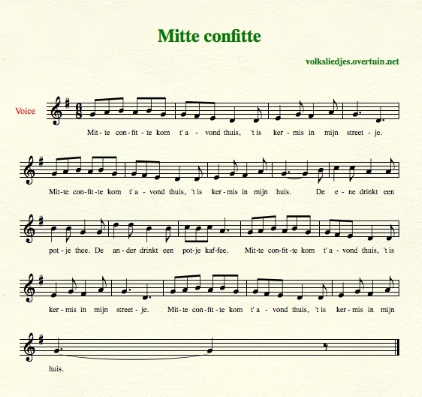
Mitte confitte you have to come home
it's fair time in my alley.
Mitte confitte you have to come home
tit's fair time in my house.
One person drinks a pot of tea
the other one a pot of coffee.
Mitte confitte you have to come home
the fair is in my alley.
Mitte confitte you have to come home
the fair is in my house.
Mitte confitte kom t' avond thuis
't is kermis in mijn streetje.
Mitte confitte kom t' avond thuis
't is kermis in mijn huis.
De ene drinkt een potje thee.
De ander drinkt een potje kaffee.
Mitte confitte kom t' avond thuis
't is kermis in mijn streetje.
Mitte confitte kom t' avond thuis
't is kermis in mijn huis.
|
|
|
Historic Dutch folk song.
Commentary: Song about the yearly fair or traveling carnival.
This folk song was written down from the oral tradition around 1879. The songwriter is unknown and the song can't be dated.
Sources (Dutch Song Database):
• Lootens en Feys, Chants Populaires flamands (1879)
• F. Coers, Liederen van Groot-Nederland (ca. 1920)
• Pollmann en Tiggers, Nederlands volkslied (1941, 1956, 1977)
• L. van Gemert, Zing! (1959)
Lyrics 'Mitte confitte kom t' avond thuis' on Dutch website: Nederlandse volksliedjes M.
|
|

- this is a thumb: click below on 'sheet music' or 'enlargement' -
|
|
© copyright translations, sheet music and music
sheet music / enlargement
play music / or click here
Mommy, a suitor's knocking on the door
fikedom fikedom fikederidom.
Mommy, a suitor's knocking on the door
hallelujah!
Moeke, doar staait 'n vrijer oan de deur
fikedom fikedom fikederidom.
Moeke, doar staait 'n vrijer oan de deur
halleluja!
Ask him if he would like to have a drink
fikedom fikedom fikederidom.
Ask him if he would like to have a drink
hallelujah!
Vroag ais wat hai drinken wil
fikedom fikedom fikederidom.
Vroag ais wat hai drinken wil
halleluja!
Tea with some grains of sugar crystal white
fikedom fikedom fikederidom.
Tea with some grains of sugar crystal white
hallelujah!
Thee met widde puntjes
fikedom fikedom fikederidom.
Thee met widde puntjes
halleluja!
Ask him if he would like something to eat
fikedom fikedom fikederidom.
Ask him if he would like something to eat
hallelujah!
Vroag ais wat hai eten wil
fikedom fikedom fikederidom.
Vroag ais wat hai eten wil
halleluja!
Barley with prunes, some porridge with dried plums
fikedom fikedom fikederidom.
Barley with prunes, some porridge with dried plums
hallelujah!
Gört met proemedanten
fikedom fikedom fikederidom.
Gört met proemedanten
halleluja!
Ask him where he would like to sleep tonight
fikedom fikedom fikederidom.
Ask him where he would like to sleep tonight
hallelujah!
Vroag ais woar hai sloapen wil
fikedom fikedom fikederidom.
Vroag ais woar hai sloapen wil
halleluja!
It is the youngest daughter he fancies
fikedom fikedom fikederidom.
It is the youngest daughter he fancies
hallelujah!
Bie de jongste dochter
fikedom fikedom fikederidom.
Bie de jongste dochter
halleluja!
Ask him about his fortune big or small
fikedom fikedom fikederidom.
Ask him about his fortune big or small
hallelujah!
Vroag ais houveul geld hai het
fikedom fikedom fikederidom.
Vroag ais houveul geld hai het
halleluja!
Has hundred thousand guilders in his purse
fikedom fikedom fikederidom.
Has hundred thousand guilders in his purse
hallelujah!
Honderddoezend gulden
fikedom fikedom fikederidom.
Honderddoezend gulden
halleluja!
Then let him in and bid him welcome here
fikedom fikedom fikederidom.
Then let him in and bid him welcome here
hallelujah!
Loat hom din moar binnkom'n
fikedom fikedom fikederidom.
Loat hom din moar binnkom'n
halleluja!
|
|
|
Historic Dutch folk song.
Commentary: Dialogue song. Lyrics in Groningen's dialect (Groningen is a province in the north of the Netherlands).
This folk song was written down from the oral tradition around 1920. The songwriter is unknown and the song can't be dated.
The song has a distinct characteristic of historic folk songs from the oral tradition: repeating sentences, which makes it easy to sing along and indicates the practise of community singing.
Content: The suitor waiting at the door can come in, as long as he possesses enough money (in times without social security, it was crucial a future husband had or could earn enough money).
Sources (Dutch Song Database):
• F.R. Coers, Liederen van Groot-Nederland (ca. 1920)
• Groen en Jager, Oude en nieuwe Groninger liederen (1930)
• P. Groen, Grunneger zangbouk (1958)
• Pollmann en Tiggers, Nederlands volkslied (1956, 1977)
Lyrics 'Moeke doar staait 'n vrijer oan de deur' on Dutch website: Nederlandse volksliedjes M.
|
|
|