|
|

- this is a thumb: click below on 'sheet music' or 'enlargement' -
|
|
© copyright translations, sheet music and music
 sheet music / enlargement sheet music / enlargement
 play music / or click here play music / or click here
Jan Double Jan, is no longer found at the yearly fair
he took off with his carriage with all his goods.
Dubbele Jan die zie je niet meer op de kermis staan
hij is er met zijn wagentje vandoor gegaan.
Jan, Jan, Jan Double Jan, where ever to did you travel
Jan, Jan, where have you gone to now?
Jan, Jan, Dubbele Jan, waar zijde ge heengevaren
Jan, Jan, waar zijde ge heengegaan?
His carriage as always was pulled by his old grey mare
who only yesterday still pulled the carousel.
Voor zijn wagen liep er een ouwe merrie mee
die gisteren nog de mallemolen draaien dee.
Jan, Jan, Jan Double Jan, where ever to did you travel
Jan, Jan, where have you gone to now?
Jan, Jan, Dubbele Jan, waar zijde ge heengevaren
Jan, Jan, waar zijde ge heengegaan?
On top of the merry-go-round he had a tinkle box
that played much nicer than the common radio.
Boven daarop daar stond een ouwe tingeldoos
die schoner speulde dan de meeste radio's.
Jan, Jan, Jan Double Jan, where ever to did you travel
Jan, Jan, where have you gone to now?
Jan, Jan, Dubbele Jan, waar zijde ge heengevaren
Jan, Jan, waar zijde ge heengegaan?
Search for Jan this evening in the moonshine light
because without him we can have no yearly fair.
Zoek die Jan vanavond in de maneschijn
want zonder Dubbele Jan kan er geen kermis zijn.
Jan, Jan, Jan Double Jan, where ever to did you travel
Jan, Jan, where have you gone to now?
Jan, Jan, Dubbele Jan, waar zijde ge heengevaren
Jan, Jan, waar zijde ge heengegaan?
|
|
|
Lyrics: Harrie Beex.
Music: Floris van der Putt.
20th century song.
Commentary: Song about an old-fashioned fairground attraction: a merry-go-round, pulled by a horse, with a tinkle box (instead of a radio) for music. The owner 'Double Jan' is gone and can't be found. Nostalgic song about the 'good old days' that are coming to an end.
The two Brabantian priests H. Beex and F. van der Putt wrote more songs about the history of (the province) Brabant, under which 'When Duke Jan arrived on his horse'.
Sources (Dutch Song Database):
• H. Beex en F. van der Putt, Den Brembosch (1947, 1950)
• L. van Gemert, Zing (1959, 1977)
 Lyrics 'Dubbele Jan' on Dutch website: Nederlandse volksliedjes D. Lyrics 'Dubbele Jan' on Dutch website: Nederlandse volksliedjes D.
|
|

- this is a thumb: click below on 'sheet music' or 'enlargement' -
|
|
© copyright translations, sheet music and music
sheet music / enlargement
play music / or click here
The siskin:
May has arrived in our land, my sweet child
please join me, come to me here outside
and I will sing to you cheerful and bright
a nice pleasant tune in your honour.
Het sijsje:
De meimaand is in 't land, lief kind
kom bij me, kom naar buiten
dan zal ik vroolijk, u ter eer
een aardig deuntje fluiten.
Tjoek tjoek tjoek, tjoeke tjoek, fuit fuit
I sing like a flute
come outside, come outside, my dearest child
tjoeke tjoek, fuit fuit
I sing like a flute
tjoeke tjoek, come outside, my dearest child!
Tjoek tjoek tjoek, tjoeke tjoek, fuït fuït
zoo klinkt er mijn lied
kom buiten, kom buiten, lief kindje
tjoeke tjoek, fuït fuït
zoo klink er mijn lied
tjoeke tjoek, kom buiten, lief kindje!
The child:
The sun has woken me early this day
I'm gladly hopping outside to you
What do you think, siskin, of the idea
that we sing a song both together?
Het kind:
De zon heeft mij reeds lang gewekt
ik kom al aangesprongen
wat dunkt je sijsjen, als wij eens
tezaam een liedje zongen?
Tjoek tjoek tjoek, tjoeke tjoek, fuit fuit
is also my song
here I am, here I am, my sweet siskin
tjoeke tjoek, fuit fuit
is also my song
tjoeke tjoek, here I am, my sweet siskin!
Tjoek tjoek tjoek, tjoeke tjoek, fuït fuït
zoo klinkt ook mijn lied.
daar ben ik, daar ben ik, lief sijsje
tjoeke tjoek, fuït fuït
zoo klink ook mijn lied
tjoeke tjoek, daar ben ik, lief sijsje!
|
|
|
Lyrics: Anna Fles.
Music: Catharina van Rennes.
19th century song.
Commentary: Dialogue song between a bird and a child.
The song book Can you still sing, then sing along, collected by teachers J. Veldkamp and K. de Boer (1906), was very popular during the whole 20th century. It sold a record of roughly a million copies. Therefore the newly written songs collected in it (which are idealistic, educational and/or carry out values), became very well-known and widespread. Read more about this iconic song book Kun je nog zingen.
Sources (Dutch Song Database):
• C. van Rennes (comp.), Jong Holland (1885)
• Veldkamp en De Boer, Kun je nog zingen (1911, 1938, 1972)
Lyrics 'De meimaand is in 't land, lief kind' on Dutch website: Nederlandse volksliedjes M.
|
|

- this is a thumb: click below on 'sheet music' or 'enlargement' -
|
|
© copyright translations, sheet music and music
sheet music / enlargement
play music / or click here
A small wooden cart, the moon was bright
drove on a sand road, so wide and quiet
the horse was eager, joyful.
I bet it finds it's way on it's own
the driver was lying, resting.
Een karretje op een zandweg reed
de maan scheen helder, de weg was breed
het paardje liep met lusten.
'k Wed dat het zelf zijn weg wel vindt
de voerman lei te rusten.
A safe journey home, my friend, my friend,
I wish you all well, my friend.
Ik wensch je wèl thuis, mêvrind, mêvrind,
ik wensch je wèl thuis, mêvrind!
An other cart drove in darkest night
through mountains on a steep, narrow path
the horse ran as an arrow
although it's blinded by snow and storm.
The driver holds the bridles.
Een karretje reed langs berg en dal
de nacht was donker, de weg was smal
het paard liep als met vleugels.
De sneeuwjacht zweept zijn oogen blind.
De voerman houdt de teugels.
A safe journey home, my friend, my friend,
I wish you all well, my friend.
Ik wensch je wèl thuis, mêvrind, mêvrind,
ik wensch je wèl thuis, mêvrind!
Just one cart comes home all safe and sound
the other coachman was lost and gone
where can he be, this poor man?
I guess you'll find him on the sand road
or just along the road side.
Eén karretje keert behouden weêr
het ander heeft er geen voerman meer
waar mag hij zijn gebleven?
'k Wed dat je 'em op den zandweg vindt
of moog'lijk wel daarneven.
He came not home safe, that friend, that friend,
he didn't do well, that friend!
Hij komt niet weer thuis, die vrind, die vrind,
hij komt niet weer thuis, die vrind!
|
|
|
Lyrics: Jan Pieter Heije.
Music: J.J. Viotta.
19th century song.
Content: Contemplative song. Not the driver on the dangerous road, but the driver on the broad, easy road falls (sleeping) of his wagon en doesn't come home. The songwriter says that sometimes a difficult road (that keeps you alert) is better than an easy ride.
Background: Songwriter J.P. Heije was deeply influenced by the ideals of the Enlightment (with education children can become virtuous and respectable citizens; also due to literature and song texts) and he wrote more idealistic songs.
Commentary: The song book Can you still sing, then sing along, collected by teachers J. Veldkamp and K. de Boer (1906), was very popular during the whole 20th century. It sold a record of roughly a million copies. Therefore the newly written songs collected in it (which are idealistic, educational and/or carry out values), became very well-known and widespread. Read more about this iconic song book Kun je nog zingen.
Sources (Dutch Song Database):
• J.P. Heije, Nederlandsche liederen (1865)
• Lange, Riemsdijk en Kalff, Nederlandsch volksliederenboek (1913)
• M. Coune, De Vlaamsche Zanger (1928)
• Veldkamp en De Boer, Kun je nog zingen (1911, 1938, 1972)
Lyrics 'Een karretje op een zandweg reed' on Dutch website: Nederlandse volksliedjes K.
|
|

- this is a thumb: click below on 'sheet music' or 'enlargement' -
|
|
© copyright translations, sheet music and music
sheet music / enlargement
play music / or click here
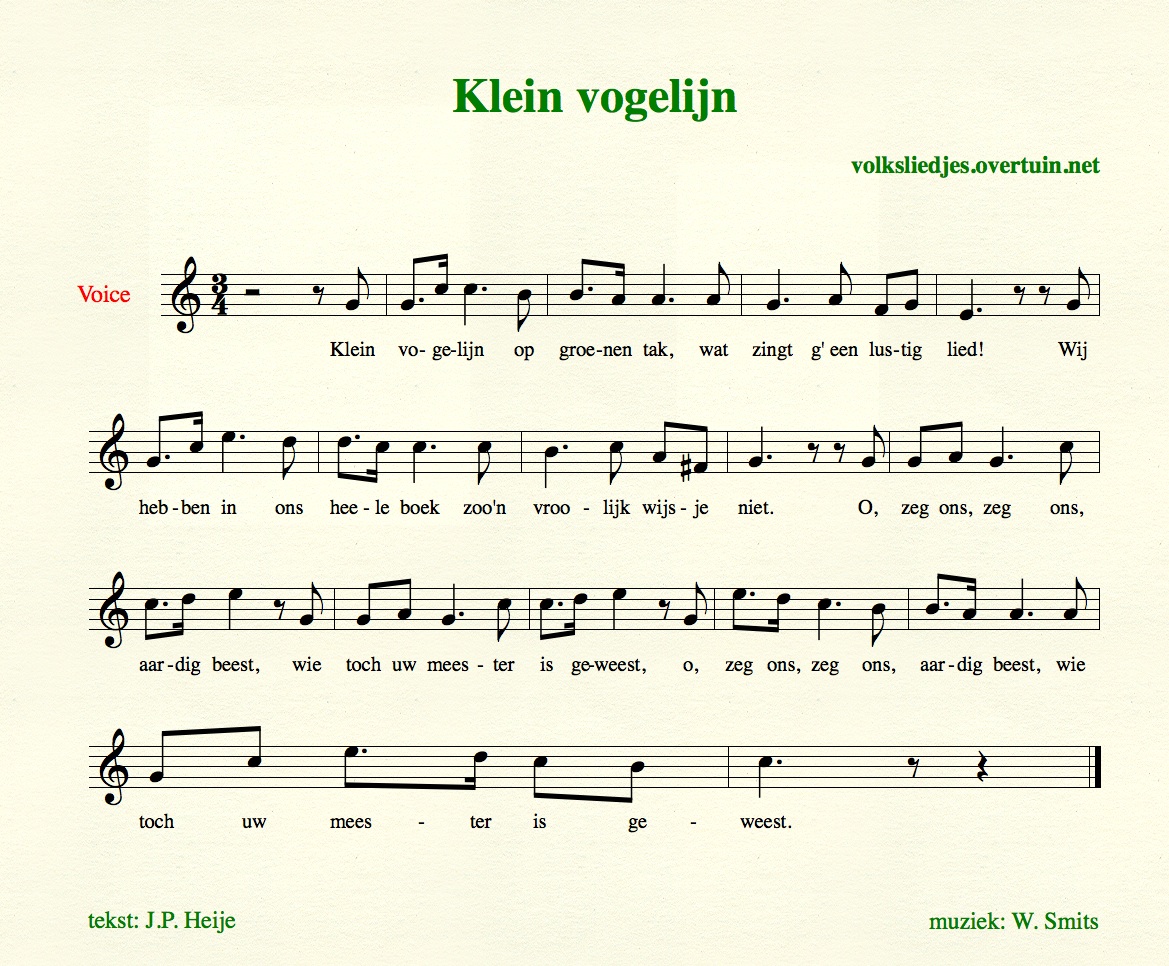
Small tiny bird on your green branch
how cheerful is your song!
In all our songbook we don't have
a song so glad and bright.
Oh, tell us, friendly animal
who was your teacher for this song?
Oh, tell us, friendly animal
who was your teacher for this song?
Klein vogelijn op groenen tak
wat zingt g' een lustig lied!
Wij hebben in ons heele boek
zoo'n vroolijk wijsje niet.
O, zeg ons, zeg ons, aardig beest
wie toch uw meester is geweest,
o, zeg ons, zeg ons, aardig beest
wie toch uw meester is geweest.
You sing so clear, so high, in tune
you keep the time so well.
Our hearts feel joy and happiness
when you begin to sing.
Oh, tell us, friendly animal
who was your teacher for this song?
Oh, tell us, friendly animal
who was your teacher for this song?
Zoo zuiver zingt gij en zoo hoog
zoo keurig in de maat
en 't hart, dat popelt ons van vreugd
wanneer uw keeltje gaat.
O, zeg ons, zeg ons, aardig beest
wie toch uw meester is geweest,
o, zeg ons, zeg ons, aardig beest
wie toch uw meester is geweest.
I know for sure that our dear God
did trust you with this song
so you could pass on to each ear
God's goodness and grandeur.
Oh yes, we know, dear animal
God was the teacher of your song,
oh yes, we know, dear animal
God was the teacher of your song.
Voorzeker 't is de goede God!
Die 't u heeft toebetrouwd
opdat gij aan der blinden oor
zijn goedheid melden zoudt.
O ja, we weten 't, aardig beest
dat God uw meester is geweest,
o ja, we weten 't, aardig beest
dat God uw meester is geweest.
|
|
|
Lyrics: Jan Pieter Heije.
Music: W. Smits.
19th century song.
Content: Contemplative, religious song. God is the source of beauty in nature.
Background: Songwriter J.P. Heije was deeply influenced by the ideals of the Enlightment (with education children can become virtuous and respectable citizens; also due to literature and song texts) and he wrote more idealistic songs.
Commentary: The song book Can you still sing, then sing along, collected by teachers J. Veldkamp and K. de Boer (1906), was very popular during the whole 20th century. It sold a record of roughly a million copies. Therefore the newly written songs collected in it (which are idealistic, educational and/or carry out values), became very well-known and widespread. Read more about this iconic song book Kun je nog zingen.
Sources (Dutch Song Database):
• J.P. Heije, Volksdichten (1876)
• Lange, Riemsdijk en Kalff, Nederlandsch volksliederenboek (1913)
• Veldkamp en De Boer, Kun je nog zingen (1911, 1938, 1972)
Lyrics 'Klein vogelijn op groene tak' on Dutch website: Nederlandse volksliedjes K.
|
|

- this is a thumb: click below on 'sheet music' or 'enlargement' -
|
|
© copyright translations, sheet music and music
sheet music / enlargement
play music / or click here
Take any path you like, take any road you like
keep up a steady pace
with smiling eyes, a willing heart
and with a stuffed up bag.
The sun is laughing happy and bright
Be welcome, twitter the birds.
I know we won't get tired soon
we keep on walking, carry on for hours.
Tra-ta-ta-ta bom bom,
tra-ta-ta-ta bom bom,
we can carry on for hours.
De paden op, de lanen in
vooruit met flinken pas
met stralend oog en blijden zin
en goed gevulde tasch.
De zonne lacht ons vroolijk toe
ons groet der voog'len zang
en wij, we worden vast niet moe
al wand'len w' uren lang.
Tra-ta-ta-ta bom bom,
tra-ta-ta-ta bom bom,
al wand'len w' uren lang.
It's true that marching is so healthy for the blood
the small chest will get wide
the muscles in the leg and foot become so strong
it stirs up appetite.
Therefore ahead and keep the time
with neat and tidy steps
walk orderly, harmonious
that is a joy for everyone.
Tra-ta-ta-ta bom bom,
tra-ta-ta-ta bom bom,
it's a joy for everyone.
Marcheeren is gezond voor 't bloed
verruimd wordt d' enge borst
't versterkt de spier van been en voet
't wekt eetlust op en dorst.
Daarom vooruit en in de maat
zoo netjes als 't maar kan
nu 't eensgezind en ord'lijk gaat
heeft elk pleizier er van.
Tra-ta-ta-ta bom bom,
tra-ta-ta-ta bom bom,
heeft elk pleizier er van.
|
|
|
Lyrics: A.L. de Rop.
Music: Richard Hol.
19th century song.
Content: Walking song. The song expresses the ideal for (city)children to go into the nature: hiking, biking, boating or camping. That would be healthy, especially for children in the city.
Commentary: The song book Can you still sing, then sing along, collected by teachers J. Veldkamp and K. de Boer (1906), was very popular during the whole 20th century. It sold a record of roughly a million copies. Therefore the newly written songs collected in it (which are idealistic, educational and/or carry out values), became very well-known and widespread. Read more about this iconic song book Kun je nog zingen.
Sources (Dutch Song Database):
• Children's cantata In den Zomer uit (1888)
• Veldkamp en De Boer, Kun je nog zingen (1911, 1938, 1972)
Lyrics 'De paden op, de lanen in' on Dutch website: Nederlandse volksliedjes P.
|
|

- this is a thumb: click below on 'sheet music' or 'enlargement' -
|
|
© copyright translations, sheet music and music
sheet music / enlargement
play music / or click here
Time flies like a passing shadow
hours, days and months and years.
Where we look, alas, we will find
nothing lasting here on earth.
Uren, dagen, maanden, jaren
vliegen als een schaduw heen.
Ach, wij vinden, waar wij staren
niets bestendigs hier beneên!
On the road we walk upon here
not one footstep will remain.
All the present will become past
though we stay responsible.
Op den weg dien wij betreden
staat gaan voetstap die beklijft.
Al het heden wordt verleden
schoon 't ons toegerekend blijft.
|
|
|
Lyrics: Rhijnvis Feith.
Music: A. Albert.
19th century song.
Content: Contemplative song and New Year's Eve song. The time flies and nothing on this earth remains. Although for everything we do, we allways will be held responsible.
Author: Rhijnvis Feith (1753-1824) was well-known around 1800 as a writer of poems and plays.
Commentary: The song book Can you still sing, then sing along, collected by teachers J. Veldkamp and K. de Boer (1906), was very popular during the whole 20th century. It sold a record of roughly a million copies. Therefore the newly written songs collected in it (which are idealistic, educational and/or carry out values), became very well-known and widespread. Read more about this iconic song book Kun je nog zingen.
The song is still sung at New Year's Eve.
Sources (Dutch Song Database):
• Evangelische Gezangen (1813)
• De Lange, Van Riemsdijk en Kalff, Nederlandsch volksliederenboek (1913)
• Veldkamp en De Boer, Kun je nog zingen (1938, 1972)
Lyrics 'Uren dagen maanden jaren' on Dutch website: Nederlandse volksliedjes U.
|
|
|